
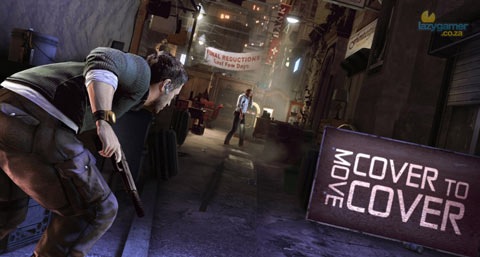
A typical scenario of Mark and Execute would go a little something like this. You use Sam’s fibre-optic gizmo to peek under a door, and see an enemy close to the door, and two more on the other side of the room. You mark all of the enemies using your right bumper, and then quietly open the door.
By hitting B you will grab the enemy in front of you, or take him hostage by holding B instead. The instant you have grabbed that enemy, you are awarded with the option to hit the Y button to perform an “execute” action. You hit Y, and Sam effortlessly takes out the marked enemies in the room.
While you may initially think that this is the most severe form of auto-aim in existance, it has a serious cool factor to it that is not only an integral part of the gameplay, but gives the player a very rewarding feeling when everything goes according to their plan. You can also mark objects such as chandeliers, gas tanks and so on, allowing Sam to slip in, hold someone hostage, crush 3 baddies with a chandelier and then dispatch of the patrolling guards with a bullet to the face.
Your ability to mark enemies is limited by the weapon you use, while certain pistols may offer the ability to mark and execute 3- 4 enemies, other weapons such as SMG’s or Assault rifles may only be able to target 2 (which can also be upgraded).
Another addition to Conviction are the interrogation sequences. Certain parts of the game will require you to beat information out of people, in order to find out who needs to get an ass-whipping next.
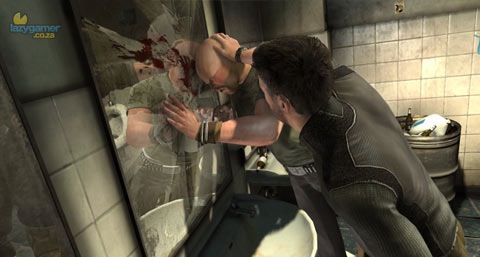
The interrogation sequences are ridiculously brutal and violent, I mean this all in a good way of course. You grab your not-so-poor victim by the throat and have the option to use elements around you to assist you in your quest for knowledge. These can get really creative and will often make you sit back in your seat and give a loud “Ooooooo” as Sam explores new ways of denting, lacerating and bloodying someone head and face.
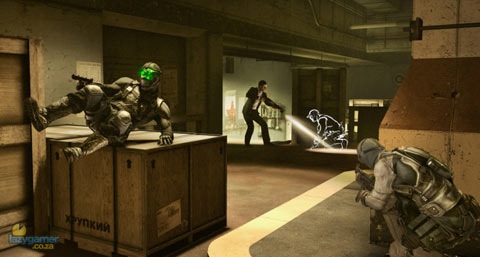
Enemies will also try and track you down based on your last known location, which is indicated by a “ghost” version of yourself, allowing you to maneuver around them and flank them while they unwittingly walk into your trap.
Your Fringe Looks Lovely
Visually, Splinter Cell has it’s very high highs but is not without it’s lows. While the Unreal engine does it’s job of looking great and delivering some really great lighting, it is the visual style and art direction that will impress you the most.
All of your mission objectives and story elements are presented to you in the form of projections onto the world. When, for example, you are being told of mission objectives, or reminded of certain characters, words will appear projected against building walls (reminds me a little of Fringe), or videos will play out onto the room floor, almost as if you are tapping into Sam’s memory. Need to know your current objective? Hit the back button and your objective will project itself onto the floor in front of you. The overall effect is very immersive and a great move from Ubisoft.
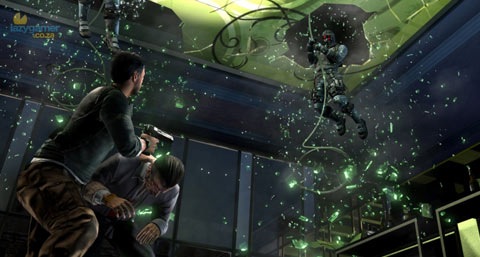
While most indoor areas in Conviction look absolutely fantastic, exteriors suffer from an age old videogame issue in that it feels more you are walking around a movie set of props, rather than an actual location. I can’t quite put my finger on it, but something just doesn’t add up, and it pulls you out of the experience that small bit.
Ubisoft also decided to make the games colour drain away to black and white to indicate that you are hidden in shadow. While this is a nice idea, it can get a little annoying. The thing is that Conviction is a really vibrant and good looking game, when it’s in colour.
The issue being that it’s a stealth game, which means that you are going to be hiding in shadows as often as possible. The end result is that you spend way too much time playing a black and white game, and only getting reminded of the games true beauty when stepping into the light, which usually means that you are about to die. It’s a nice idea that ended up taking away some of the games magic instead of adding to it, but in all fairness, it’s not that bad.
Do You Like The Sam-ba?
A great deal of effort has been pumped into making Splinter Cell: Conviction sound as good as it looks. The game features fantastic voice acting, especially with the wonderful Michael Ironside returning to voice Sam Fisher. What surprised me the most is that Conviction has a really great soundtrack, and one that feels significantly different to the norm.
Music will change according to your situation, speeding up as you encounter enemies and so on. Every now and then however, you will play through a sequence that will be accompanied by an original piece of music that really draws you into the tension of the sequence in a kind of Portishead-like sound that is as haunting as it is tense.
The storyline is decent but can get a little weak at times, often drawing off of the aforementioned magic of it’s visual and sound direction to keep things feeling really worthwhile.
Campaign Envy?
While we are on the topic of the story, let’s discuss its length. The news that you have heard is true, but also not. Let me explain.
Splinter Cell: Convictions main campaign involving Sam Fisher is short by most videogame standards. I played the game on Normal difficulty (you also have the option of easy and realistic) and thanks to my own obsession with getting certain stealth sections right often redid some sections over until I was happy that I didn’t make a complete mess of things. Even though I replayed those sections, and also battled with some very terribly long checkpoints, managed to finish the game in around 7 hours.
Without the obsessive need for perfection and an easier difficulty it wouldn’t be too tough to finish the game in 5-6 hours, but as I said earlier, there is more to Conviction than most people realise.
Along with the Sam Fisher campaign, Conviction also has an entirely separate two-player co-op campaign story called Deniable Ops that runs alongside it as well as multiplayer co-op modes that can be played over and over again.
Last Updated: April 16, 2010
| Splinter Cell: Conviction | |
|
|
|
|---|---|


















koldFU5iON
April 16, 2010 at 12:56
Nice review Nick, next time your my partner though we’re going to have to work on your sneakiness… less rabbit in the lights effects
Nick de Bruyne
April 16, 2010 at 13:13
Whatever Pipe-Boy
koldFU5iON
April 16, 2010 at 16:07
My pipes saved your life! I’ve got the stats to prove it!
batman
April 16, 2010 at 13:51
Can I ask a serious question? What would Megarom/Ubisoft do if you reviewed this game and gave it a 7 instead of an over inflated score?
Geoff
April 16, 2010 at 13:56
Probably the same thing Square/Nu Metro did when I gave final Fantasy XIII a less than perfect score.
Not a damn thing.
Bobby Kotick phones Agent 47
April 16, 2010 at 14:22
You’re a rebel Geoff! 😮
*Bobby Kotick phones an assassin*
Unknown Caller: Good afternoon Mr Kotick.
Bobby K: 47, I have a problem.
Agent 47: Sir, you have to see a doctor about that itch.
Bobby K: (Coughs) Uh.. yes.. uh.. anyway we have this game reviewer from Africa. He insists on not buying into the hype and he has the audacity of giving games less than perfect scores.
Agent 47: I understand sir.
Bobby K: This can not be allowed to continue. I want this taken care of Agent 47. As always, the usual fee, and please make it look like he slipped off the toilet seat.
Agent 47: It will be done, sir.
Geoff
April 16, 2010 at 14:07
I haven’t played the game yet, so I’m not really able to support,
or challenge Nick’s score – but it’s not out of line with the
metacritic ranking, so you can’t really call it over inflated.
http://bit.ly/dnqrKb
Nick de Bruyne
April 16, 2010 at 14:37
We review games, not companies. It is very important that we don’t allow external factors to affect our review scores and we take that very seriously.
Take the Red Steel 2 review (also Ubi/Megarom) from this week for instance, it got a 7.5 because that’s what I felt it deserved. It’s a review and that’s that.
If you want a real example of overinflated, I noticed that GamePro gave Conviction a perfect score, and while I think the game is really great, it is very clear that it’s not worthy of a 10/10.
krYtHan
April 16, 2010 at 14:18
The storyline is decent but can get a little “week” at times…
Weak, not week.
Nick de Bruyne
April 16, 2010 at 14:28
Whoops, thanks, it was 5am (excuses excuses I know) 😛
uberutang
April 16, 2010 at 14:45
I rate it a solid 7/10. Need to still try coop and MP.
MooseWrangler
April 16, 2010 at 15:02
Please Janrik everyone knows that you pirate all you Xbox 360 games so keep your opinions to yourself you dont know what a games worth is when you DL everything you want always
Mannic
April 16, 2010 at 15:03
Just wish all the other SA game blogs got their game when you did for review. As usual this is the only SA review up on release day!!! So this is the only review I can go on until next week :/
Nick de Bruyne
April 16, 2010 at 15:08
I think they did, I just played the living snot out of it to get it out on time.
Why not just hit up some international sites for their reviews?
Mannic
April 16, 2010 at 15:22
local cap at work no cap at home . the randomness of local support is bull !!
Nick de Bruyne
April 16, 2010 at 15:36
If im not mistaken we are hosted on overseas servers now?
Geoff
April 16, 2010 at 15:38
Are – and have been for a long, long time.
Fox1
April 16, 2010 at 15:56
Watch the review on gametrailers.com. It works on local cap 🙂
Mannic
April 16, 2010 at 16:01
cellphone :/ great side step okes ! my point is LOCAL support is random. We have to rely on the world for reviews? why can’t I stick with like mined LOCAL reviews. 1 review on release day is poor
Geoff
April 16, 2010 at 16:07
As Nick said, all the major SA sites tend to get the games at the same time – usually a day or two before release. It’s really up to other sites to get their reviews up in the really short times available to them.
Nick and I have been known to stay up until the weeeeeeeeeeeee hours of the morning just to make sure we have our reviews out on time.
koldFU5iON
April 16, 2010 at 16:12
awe have cookie 🙂
Geoff
April 16, 2010 at 16:22
No Milk?
I WILL NOT PUT UP WITH THIS SHIT!
WitWolfyZA
April 22, 2010 at 08:27
Now thats dedicated!!!
...squirrel
April 16, 2010 at 19:37
you guys know when the pc version will be out?
Geoff
April 16, 2010 at 19:53
April 30th, I believe.
...squirrel
April 19, 2010 at 18:08
ah, that would explain alot :pinch: thanks Geoff :biggrin:
Maxiviper
April 16, 2010 at 21:10
I won this game on the Verge Show….ooh yes! :biggrin:
mitas
April 22, 2010 at 01:17
verge ok , playR ok , game face = fail big time , i am sure we have enough local talent to make up that fake brit and her tramp stamp tat – peace
WitWolfyZA
April 22, 2010 at 08:28
I never watch the Vurge.. why watch The Vurge if all your gaming needs are on this very site :biggrin:
xbox360games
April 17, 2010 at 03:39
aha, i know what u mean. but when my pc get’s a blue screen i can reset it.. and there is no problem after all. Is that with the xbox the same. or do i have to get a new xbox?
Ryan
April 19, 2010 at 06:46
Splinter Cell Convictions is an awesome game. My only complaint was the clipping problem with the Co-Op. If you mark someone then you can shoot through walls.
koldFU5iON
April 19, 2010 at 12:43
nope Sam’s just that good 😉 haha
T.L.Blade
April 21, 2010 at 17:12
Kestrel is working for Voron (Raven) not for Third Echelon and thats point of coop – two rival groups (USA – Third Echelon X Russia – Voron) are working together.
Nick de Bruyne
April 21, 2010 at 18:13
You are very correct, I just noticed this mistake recently, consider it fixed.
lans
April 21, 2010 at 20:05
Excellent review
I ended up getting splinter cell from an undisclosed source and ive had time to sample it, its ace, i like the music,i like the pace of the game and the variety, this seems to be an unfinished game though, i wish splintercell had more CQC, more ways of disarming and dispatching a target, and more sneeking, etc like sneeking under a truck then pulling someones feet and pulling him under the truck or other stuff. i wish splintercell had more gadgets like a tazer gun, or high tech traps you can set, ie using running holograms that look like sam etc.
other rants, sam speaks too much, and enemies bitch too much and do the same lame repitions over and over again AND WHY CAN I ONLY ROLE FORWARDS WTH! sure you can role sideways, but the animation always orients the character to the direction you want to roll then does a foward roll which takes forever, i think the game would be soo much more hectic if you could sideays rolls, really quickly, you could roll behind a wall when they close you role to the same poition and take em out, currently you have to only do a forwards roll which takes time and you do not end up in the same position you usually end up behind the enemy thenn you got turn quickly and grab him, which is messy coz u dont know whats happening really, someimes you roll badly forwards and get suffocated in co-op, and by that time, someone would have shot you with a shotgun wtf!
and why are the graphics physics so bad in co-op, they so many guns stuck in walls when you kill people, and sometimes the wall goes into the characters at a load and we get stuck, or the game freezes. the game world is so bad sometimes you can shoot someone through 5 solid walls if you mark and execute, but the worst part is the enemy does the same to you, the enemy is able to shoot through many walls as if they’re not walls, this leads to many cheap deaths.!
Splinter cell 7/10 the game is not polished, so if it was 8.5 out of 10 but i dont beleive in review scores anyway
Potty391
April 21, 2010 at 21:03
LOL! “…Undisclosed source…”. I can disclose it for you, it’s called the Pirate Bay 😀
Nick de Bruyne
April 22, 2010 at 00:57
Yeah lol what’s with that? Unless the place you buy your games from also sells meth, I don’t see any reason for you to withhold it’s name.
mitas
April 22, 2010 at 01:19
meth ? really ? thought everyone was on coke – dam neede to switch – other wise yeah pircy is big not gana change anytime soon , sory dev’s we need the games —– cough * mw2 * cough
lans
April 22, 2010 at 07:30
the source is undisclosed, period you not getting a peep from me ever!
mitas
April 22, 2010 at 01:23
@lazy – really top nouch with the “news that didn make it ” its a nice touch and helps with reading more
ps – wont you include some of the sites that you rate as ” tops ” as i am getting bord with ign , gamespot etc etc i wanna see more oppions – even if other ppl dont like it
Gavin Mannion
April 22, 2010 at 08:28
All the credit goes to Nick on that one to be honest and I had forgotten about those sites listed there…
Off the top of my head I can’t think of many other big sites out there that are worth reading. I struggle to get through Gamespot and or read much on IGN to be honest.. I like Kotaku, Joystiq and Destructoid though… oh and VG247
mitas
April 22, 2010 at 14:14
thanks
Alterboy-Preist'sToy
April 22, 2010 at 08:28
This game was very underwhelming, I was so excited when my girlfriend bought this game that I broke my bed jumping for joy on it. The joy was short lived as I was presented with dated graphics, glitches, a mheh story, Binary AI and irritating music(that’s if you decide to just sneak past the guards and not kill them, the music just fucken irritates the bubbling shit out my arse). and the ‘action’ they promised, nowhere to be seen. Playing this game for action was as good as watching a softporn for cumshots.
I rate it 5 out of 10.
good review though, nick.
Grant Hinds
April 23, 2010 at 12:25
Awesome review bro! Comprehensive 🙂
Con
July 5, 2010 at 00:49
Should i buy this game? Anyone
Nick de Bruyne
July 5, 2010 at 02:03
If you scroll up, you will notice that there is a rather large review that may help you out with that answer
Rdr rocks
July 6, 2010 at 15:51
I dont have xbl so what iam really want to know does this game have replay value. And that review looks really long to read and has to many big words in it sorry nick you smartass
Nick de Bruyne
July 6, 2010 at 16:05
The single player doesn’t have MASSIVE replay value, but many will want to go back to do it on the toughest setting.
However, the multiplayer missions can be played alone or with a buddy, and even though you don’t have Xbox Live I would strongly suggest that you get a buddy over and play the co-op stuff in split-screen, it’s really awesome.
They have a lot more replay value than the single player for sure
Rdr rocks con
July 6, 2010 at 16:11
Well that does sound nice. Now i just need to pick up a cheap second hand copy. Cheers nick
Con
July 6, 2010 at 18:29
Yo nick i was just wondering what country are you from. Because my friend thinks your from britain and i think your maybe american. I am from Ireland so please be american cause i have 5 euro on this!
Nick de Bruyne
July 6, 2010 at 18:34
Sorry to disappoint the lot of you, I’m South African. Does that mean that I win the 5 Euros?
Con
July 6, 2010 at 18:57
were both wrong, damn . Fair enough i will send that fiver in the post not sure about the currency rates though good luck
Conor
July 29, 2010 at 22:07
I bought it Nick. This game better be good or i’ll well complain or something. Got it for only €9 SHAZAM
Nick de Bruyne
July 29, 2010 at 23:39
For that price, you can’t go wrong
Conor
July 31, 2010 at 13:19
Yo Nick splitter cell is good so for. I havnt completed yet but really good fun . The only thing that annoys about the game is i always press x to reload (cod style xbox) my weapon then i end up throwing a gadget and that alerts my position. it drives me mad :-(. And also Sams voice sounds funny